


Page 67 - Azerbaijan State University of Economics
P. 67
THE JOURNAL OF ECONOMIC SCIENCES: THEORY AND PRACTICE, V.78, # 2, 2021, pp. 63-73


                           Strategic planning is described as a "purposeful, systematic activity to make
                           proper  decisions  and  actions  that  shape  and  control  firm  purposes  and
                           objectives, what it does, and why" (Bryson 2011, 7–9), according to Bryson
                           et  al  (2018).  Organizations  throughout  the  world  are  constantly  utilizing
                           strategic planning that meets this requirement, according to the report. It can
                           also  be  used  on  entire  firms  or  sections  of  them,  indicating  that  if  this
                           technique is implemented in gold mining in Sudan, the firms may be able to
                           meet  their  goals  and  objectives.  Strategic  planning  is  a  subset  of  strategic
                           management,  which  integrates  planning  and  execution  Albrechts,  L.,
                           Balducci,  A., &  Hillier, J.  (2016). while J. L. Kaufman and H. M. Jacobs
                           (1987) believe that many of the ideas embodied in this technique, they claim,
                           have indeed been part of planning curricula for years, but most managers see
                           it as "old wine in new bottles." However, they feel that the overwhelming
                           adoption  of  project  planning  and implementation  should  be  viewed  as  an
                           opportunity to revive engagement throughout the field. Akinyele, S. T., &
                           Fasogbon, O. I. (2010). The study's findings suggest that strategic planning
                           leads  to  higher  firms’ performance,  which  also  influences  the  company’s
                           long  existence,  and  that  strategic  planning  intensity  is  influenced  by
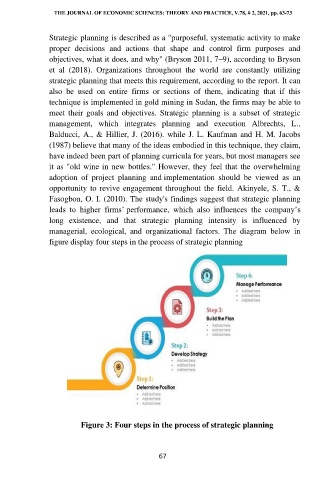
                           managerial,  ecological,  and  organizational  factors.  The  diagram  below  in
                           figure display four steps in the process of strategic planning


                                    Figure 3: Four steps in the process of strategic planning


                                                           67

