


Page 25 - Azerbaijan State University of Economics
P. 25
THE        JOURNAL OF ECONOMIC SCIENCES: THEORY AND PRACTICE, V.80, # 1, 2023, pp. 21-34

                    Despite various studies on non-competitive locating, a great part of studies have been
                    based on geographical methods and this issue has been rarely studied from economics
                    and the theoretical expansion of locating models of agents has been rarely considered
                    in studies. Moreover, the existing locating models have been planned based on
                    simplification assumptions such as linear city (one street) and the presence of one or
                    two agents. Therefore, this paper intends to propose a theoretical modeling with
                    assumptions that are closer to reality and could provide the ground for selection of
                    optimum  number  of  agents  and  optimum  distribution  of  their  locations.

                    PRESENTATION OF MODEL
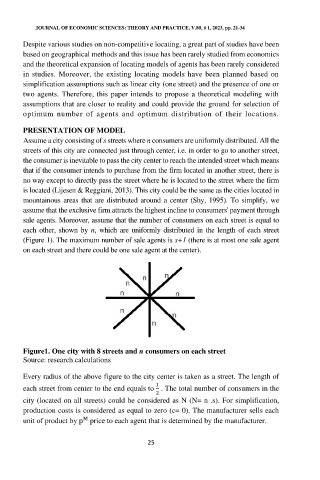
                    Assume a city consisting of s streets where n consumers are uniformly distributed. All the
                    streets of this city are connected just through center, i.e. in order to go to another street,
                    the consumer is inevitable to pass the city center to reach the intended street which means
                    that if the consumer intends to purchase from the firm located in another street, there is
                    no way except to directly pass the street where he is located to the street where the firm
                    is located (Lijesen & Reggiani, 2013). This city could be the same as the cities located in
                    mountainous areas that are distributed around a center (Shy, 1995). To simplify, we
                    assume that the exclusive firm attracts the highest incline to consumers' payment through
                    sale agents. Moreover, assume that the number of consumers on each street is equal to
                    each other, shown by n, which are uniformly distributed in the length of each street
                    (Figure 1). The maximum number of sale agents is s+1 (there is at most one sale agent
                    on each street and there could be one sale agent at the center).


                    Figure1. One city with 8 streets and n consumers on each street
                    Source: research calculations

                    Every radius of the above figure to the city center is taken as a street. The length of
                                                              1
                    each street from center to the end equals to   . The total number of consumers in the
                                                              2
                    city (located on all streets) could be considered as N (N= n .s). For simplification,
                    production costs is considered as equal to zero (c= 0). The manufacturer sells each
                                       M
                    unit of product by p  price to each agent that is determined by the manufacturer.


                                                           25

