


Page 30 - Azerbaijan State University of Economics
P. 30
Salah Salimian, Kiumars Shahbazi, Mahdi M. Beknazar: Locating The Sale Agents In Spoke Model
                             Through Uniform Distribution Of Consumers


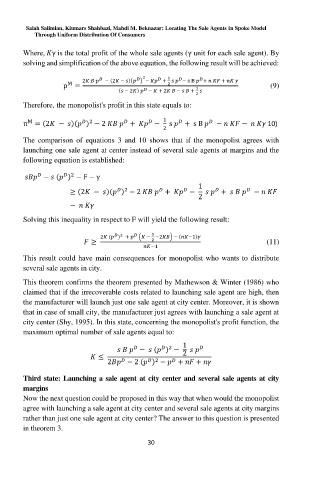
                    Where,   γ is the total profit of the whole sale agents (γ unit for each sale agent). By
                    solving and simplification of the above equation, the following result will be achieved:

                                                          2
                                                                  1


                                       2           − (2   −   )(   ) −       +   s    − s B    +         +
                                  M
                                 p =                              2        1                             (9)

                                                  (   − 2  )    −    + 2      −       +
                                                                           2

                    Therefore, the monopolist's profit in this state equals to:

                                                                1


                                         2

                     M

                    π = (2    −    )(   ) − 2         +       −   s    +  s B     −         −          10)
                                                                2

                    The  comparison  of  equations  3  and  10  shows  that  if  the  monopolist  agrees  with
                    launching one sale agent at center instead of several sale agents at margins and the
                    following equation is established:

                                    2

                           −    (   ) − F − γ
                                                                            1

                                                     2


                                   ≥ (2    −    )(   ) − 2         +       −         +            −
                                                                            2
                                   −

                    Solving this inequality in respect to F will yield the following result:


                                                    2
                                            2   (   )   +     (   −   −2    ) − (    −1)
                                          ≥                  2                                                 (11)
                                                              −1

                    This result could have main consequences for monopolist who wants to distribute
                    several sale agents in city.

                    This theorem confirms the theorem presented by Mathewson & Winter (1986) who
                    claimed that if the irrecoverable costs related to launching sale agent are high, then
                    the manufacturer will launch just one sale agent at city center. Moreover, it is shown
                    that in case of small city, the manufacturer just agrees with launching a sale agent at
                    city center (Shy, 1995). In this state, concerning the monopolist's profit function, the
                    maximum optimal number of sale agents equal to:

                                                                       1

                                                                   2
                                                           −     (   ) −
                                            ≤                          2
                                                              2


                                               2     − 2 (   ) −    +      +

                    Third state: Launching a sale agent at city center and several sale agents at city
                    margins
                    Now the next question could be proposed in this way that when would the monopolist
                    agree with launching a sale agent at city center and several sale agents at city margins
                    rather than just one sale agent at city center? The answer to this question is presented
                    in theorem 3.
                                                           30

