


Page 10 - Azerbaijan State University of Economics
P. 10
THE                      JOURNAL OF ECONOMIC SCIENCES: THEORY AND PRACTICE, V.81, # 2, 2024, pp. 4-29

                    • Scenario  analysis:  Internal  and  external  loss  databases  focus  on  what  has  already
                    happened, while scenario analysis contributes to suggesting what may happen, even if it
                    has not happened before, and then it should be intended not only to supplement existing
                    internal data when estimating the impact of potentially rare but highly impactful events,
                    but also to represent an ongoing exercise to anticipate potential new risks that may result
                    from changes in the external environment as well as from internal changes. (Saita, 2007).
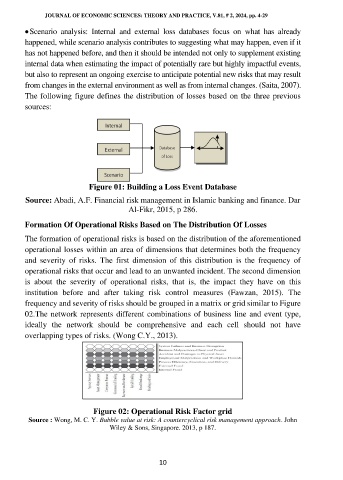
                    The following figure defines the distribution of losses based on the three previous
                    sources:


                                       Figure 01: Building a Loss Event Database

                    Source: Abadi, A.F. Financial risk management in Islamic banking and finance. Dar
                                                  Al-Fikr, 2015, p 286.

                    Formation Of Operational Risks Based on The Distribution Of Losses

                    The formation of operational risks is based on the distribution of the aforementioned
                    operational losses within an area of dimensions that determines both the frequency
                    and  severity  of  risks.  The  first  dimension  of  this  distribution  is  the  frequency  of
                    operational risks that occur and lead to an unwanted incident. The second dimension
                    is  about  the  severity  of  operational  risks,  that  is,  the  impact  they  have  on  this
                    institution  before  and  after  taking  risk  control  measures  (Fawzan,  2015).  The
                    frequency and severity of risks should be grouped in a matrix or grid similar to Figure
                    02.The network represents different combinations of business line and event type,
                    ideally  the  network  should  be  comprehensive  and  each  cell  should  not  have
                    overlapping types of risks. (Wong C.Y., 2013).


                                        Figure 02: Operational Risk Factor grid
                     Source : Wong, M. C. Y. Bubble value at risk: A countercyclical risk management approach. John
                                             Wiley & Sons, Singapore. 2013, p 187.


                                                           10

