


Page 11 - Azerbaijan State University of Economics
P. 11
Aimene Farid, Bahi Nawel:Operational Risk Estimation Using the Value-at-Risk (VAR)
                                   Method: Case Study of the External Bank of Algeria (EBA)


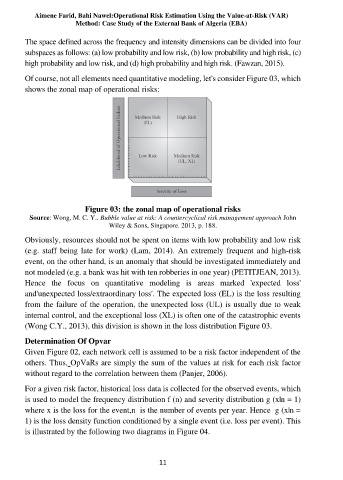
                    The space defined across the frequency and intensity dimensions can be divided into four
                    subspaces as follows: (a) low probability and low risk, (b) low probability and high risk, (c)
                    high probability and low risk, and (d) high probability and high risk. (Fawzan, 2015).

                    Of course, not all elements need quantitative modeling, let's consider Figure 03, which
                    shows the zonal map of operational risks:


                                      Figure 03: the zonal map of operational risks
                     Source: Wong, M. C. Y.. Bubble value at risk: A countercyclical risk management approach John
                                             Wiley & Sons, Singapore. 2013, p. 188.

                    Obviously, resources should not be spent on items with low probability and low risk
                    (e.g. staff being late for work) (Lam, 2014). An extremely frequent and high-risk
                    event, on the other hand, is an anomaly that should be investigated immediately and
                    not modeled (e.g. a bank was hit with ten robberies in one year) (PETITJEAN, 2013).
                    Hence  the  focus  on  quantitative  modeling  is  areas  marked  'expected  loss'
                    and'unexpected loss/extraordinary loss'. The expected loss (EL) is the loss resulting
                    from the failure of the operation, the unexpected loss (UL) is usually due to weak
                    internal control, and the exceptional loss (XL) is often one of the catastrophic events
                    (Wong C.Y., 2013), this division is shown in the loss distribution Figure 03.

                    Determination Of Opvar
                    Given Figure 02, each network cell is assumed to be a risk factor independent of the
                    others. Thus, OpVaRs are simply the sum of the values at risk for each risk factor
                    without regard to the correlation between them (Panjer, 2006).

                    For a given risk factor, historical loss data is collected for the observed events, which
                    is used to model the frequency distribution f (n) and severity distribution g (x|n = 1)
                    where x is the loss for the event,n  is the number of events per year. Hence  g (x|n =
                    1) is the loss density function conditioned by a single event (i.e. loss per event). This
                    is illustrated by the following two diagrams in Figure 04.


                                                           11

