


Page 108 - Azerbaijan State University of Economics
P. 108
THE                      JOURNAL OF ECONOMIC SCIENCES: THEORY AND PRACTICE, V.81, # 2, 2024, pp. 104-116

                    In early 1990, China's employment rates rose as a result of economic programs and
                    reforms  aimed  at  improving  labour  market  conditions  by  emphasising  skilled
                    employment and acknowledging human capital as an essential element of production
                    that adds value across all economic sectors, leading to enhanced working conditions
                    in urban and rural areas (Ghose, 2005).

                    In 2015, the employment rate declined by 4.97% due to substantial pressure on Chinese
                    exports  and  the  yuan  from  global  economic  turbulence,  leading  to  lower  worldwide
                    demand, limited investment, and the robust performance of the United States dollar.
                    During this era, China's GDP expanded by 6.9%, marking its most sluggish growth rate
                    since 1990. In 2014, growth reached 7.3%, resulting in a decline in China's employment
                    rate, among other issues such as substantial population growth. In 2022, the employment
                    rate decreased to 4.83% due to declining oil prices and the repercussions of the global
                    COVID-19  pandemic,  which  has  significantly  affected  the  economies  of  countries
                    worldwide.

                    Human Capital Development Index (HDI)
                    Notwithstanding  rising  economic  apprehensions  China  persists  in  advancing  its
                    human  development  objectives  both  locally  and  internationally.  In  2022,  China's
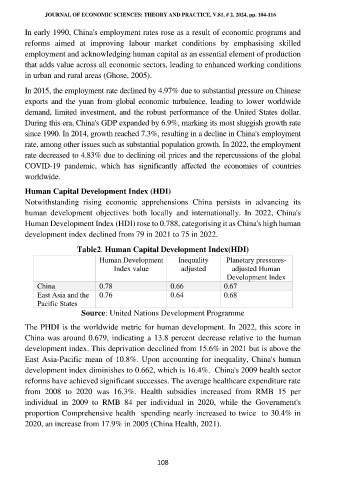
                    Human Development Index (HDI) rose to 0.788, categorising it as China's high human
                    development index declined from 79 in 2021 to 75 in 2022.

                                   Table2. Human Capital Development Index(HDI)
                                          Human Development      Inequality    Planetary pressures-
                                              Index value         adjusted       adjusted Human
                                                                               Development Index
                       China              0.78                 0.66            0.67
                       East Asia and the   0.76                0.64            0.68
                       Pacific States
                                    Source: United Nations Development Programme
                    The PHDI is the worldwide metric for human development. In 2022, this score in
                    China was around 0.679, indicating a 13.8 percent decrease relative to the human
                    development index. This deprivation decclined from 15.6% in 2021 but is above the
                    East Asia-Pacific mean of 10.8%. Upon accounting for inequality, China's human
                    development index diminishes to 0.662, which is 16.4%.  China's 2009 health sector
                    reforms have achieved significant successes. The average healthcare expenditure rate
                    from  2008  to  2020  was  16.3%.  Health  subsidies  increased  from  RMB  15  per
                    individual  in  2009  to  RMB  84  per  individual  in  2020,  while  the  Government's
                    proportion Comprehensive health   spending nearly increased to twice  to 30.4% in
                    2020, an increase from 17.9% in 2005 (China Health, 2021).


                                                           108

