


Page 45 - Azerbaijan State University of Economics
P. 45
Mbu Daniel Tambi, Mah-Soh Glennice Fosah: Econometric Modelling of Women
                                Empowerment and Agricultural Production in Cameroon

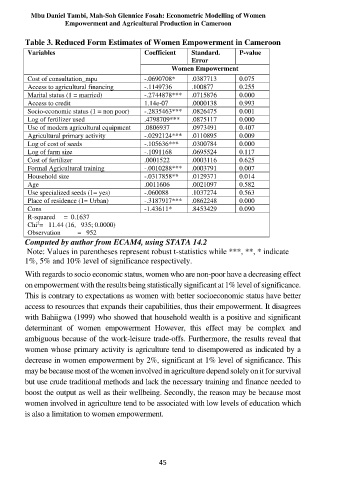
                    Table 3. Reduced Form Estimates of Women Empowerment in Cameroon
                     Variables                         Coefficient   Standard.     P-value
                                                                     Error
                                                               Women Empowerment
                     Cost of consultation_mpu          -.0690708*    .0387713      0.075
                     Access to agricultural financing   -.1149736    .100877       0.255
                     Marital status (1 = married)      -.2744878***   .0715876     0.000
                     Access to credit                  1.14e-07      .0000138      0.993
                     Socio-economic status (1 = non poor)   -.2835463***   .0826475   0.001
                     Log of fertilizer used            .4798709***   .0875117      0.000
                     Use of modern agricultural equipment    .0806937   .0973491   0.407
                     Agricultural primary activity     -.0292124***   .0110895     0.009
                     Log of cost of seeds              -.105636***   .0300784      0.000
                     Log of farm size                  -.1091168     .0695524      0.117
                     Cost of fertilizer                .0001522      .0003116      0.625
                     Formal Agricultural training      -.0010288***   .0003791     0.007
                     Household size                    -.0317858**   .0129371      0.014
                     Age                               .0011606      .0021097      0.582
                     Use specialized seeds (1= yes)    -.060088      .1037274      0.563
                     Place of residence (1= Urban)     -.3187917***   .0862248     0.000
                     Cons                              -1.43611*     .8453429      0.090
                     R-squared     =  0.1637
                       2
                     Chi =   11.44 (16,   935; 0.0000)
                     Observation          =   952
                    Computed by author from ECAM4, using STATA 14.2
                     Note: Values in parentheses represent robust t-statistics while ***, **, * indicate
                    1%, 5% and 10% level of significance respectively.

                    With regards to socio economic status, women who are non-poor have a decreasing effect
                    on empowerment with the results being statistically significant at 1% level of significance.
                    This is contrary to expectations as women with better socioeconomic status have better
                    access to resources that expands their capabilities, thus their empowerment. It disagrees
                    with Bahiigwa (1999) who showed that household wealth is a positive and significant
                    determinant  of  women  empowerment  However,  this  effect  may  be  complex  and
                    ambiguous because of the work-leisure trade-offs. Furthermore, the results reveal that
                    women whose primary activity is agriculture tend to disempowered as indicated by a
                    decrease in women empowerment by 2%, significant at 1% level of significance. This
                    may be because most of the women involved in agriculture depend solely on it for survival
                    but use crude traditional methods and lack the necessary training and finance needed to
                    boost the output as well as their wellbeing. Secondly, the reason may be because most
                    women involved in agriculture tend to be associated with low levels of education which
                    is also a limitation to women empowerment.


                                                           45

