


Page 44 - Azerbaijan State University of Economics
P. 44
THE                      JOURNAL OF ECONOMIC SCIENCES: THEORY AND PRACTICE, V.82, # 1, 2025, pp. 36-51

                    This expansion was driven by the adoption of technological innovations from Western
                    countries, which represent key intensive factors of economic growth in the oil sector.
                    Initially, drilling in the Caspian Sea reached depths of 500 meters—exceeding the
                    Soviet-era limit of 150 meters—and current capabilities now extend to 1,000 meters.
                    Amid this period of economic growth, Azerbaijan faced pressures from major powers,
                    notably the United States, which advocated for an oil export pipeline route through
                    Armenian  territory.  Nevertheless,  Azerbaijan’s  resolute  position  facilitated  the
                    construction of the Baku-Tbilisi-Kars pipeline, which avoids the Republic of Armenia
                    by  traversing  Georgia.  This  pipeline  commenced  operations  on  June  13,  2006.
                    Complementing this, the Baku-Tbilisi-Ceyhan (BTC) main export pipeline transports
                    crude oil from the Azeri-Chirag-Gunashli and Shah Deniz fields in the Azerbaijani
                    sector of the Caspian Sea to the Ceyhan port in Turkey, enabling onward distribution
                    to European markets via the Mediterranean Sea. Since its inception, the BTC pipeline
                    has also facilitated the transit of crude oil from Turkmenistan, and, as of October 2013,
                    BTC Co. has expanded its operations to include a portion of the crude oil extracted
                    from  Kazakhstan’s  Tengiz  field.  This  infrastructure  continues  to  underpin
                    Azerbaijan’s integration into European markets and its cooperation with European
                    nations. Additionally, the South Caucasus Pipeline plays a vital role in bolstering the
                    country’s economic growth.


                                                         39.68
                                                               37.09
                        34.88
                                         31.12
                                                                    29.37  27.82
                                                    26.29
                                                                                          25.31
                                              22.43
                              19.62                                            20.48
                                                                                                15.28
                                                                                     13.20


                                    3.66


                        1993  1994  1995  1996  1997  1998  1999  2000  2001  2002  2003  2004  2005  2006  2007  2008  2009  2010  2011  2012  2013  2014  2015  2016  2017  2018  2019  2020

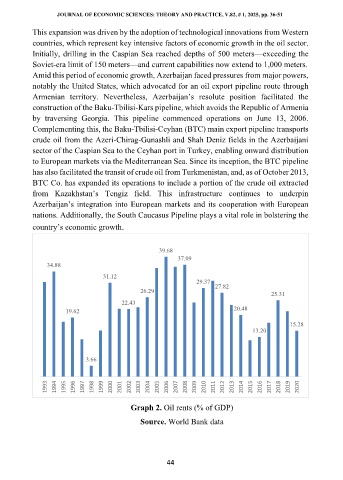
                                                 Graph 2. Oil rents (% of GDP)

                                                    Source. World Bank data


                                                           44

