


Page 100 - Azerbaijan State University of Economics
P. 100
THE                 JOURNAL OF ECONOMIC SCIENCES: THEORY AND PRACTICE, V.82, # 2, 2025, pp. 96-116


                                                        2
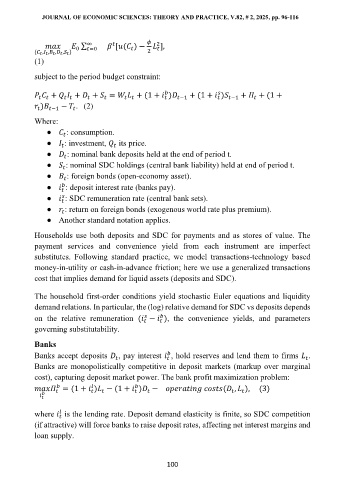
                                  ∑ ∞       [  (   ) −    ],

                                0

                                     =0
                    {      ,      ,      ,      ,      }  2
                    (1)

                    subject to the period budget constraint:


                          +       +    +    =       + (1 +    )     −1  + (1 +    )     −1  +    + (1 +


                       )     −1  −    .   (2)


                    Where:
                       ●     : consumption.

                       ●     : investment,     its price.


                       ●     : nominal bank deposits held at the end of period t.

                       ●     : nominal SDC holdings (central bank liability) held at end of period t.

                       ●     : foreign bonds (open-economy asset).


                       ●     : deposit interest rate (banks pay).


                       ●     : SDC remuneration rate (central bank sets).

                       ●     : return on foreign bonds (exogenous world rate plus premium).

                       ●  Another standard notation applies.

                    Households use both deposits and SDC for payments and as stores of value. The
                    payment  services  and  convenience  yield  from  each  instrument  are  imperfect
                    substitutes.  Following  standard  practice,  we  model  transactions-technology  based
                    money-in-utility or cash-in-advance friction; here we use a generalized transactions
                    cost that implies demand for liquid assets (deposits and SDC).

                    The household first-order conditions yield stochastic Euler equations and liquidity
                    demand relations. In particular, the (log) relative demand for SDC vs deposits depends


                    on  the  relative  remuneration  (   −    ),  the  convenience  yields,  and  parameters


                    governing substitutability.

                    Banks

                    Banks accept deposits    , pay interest    , hold reserves and lend them to firms    .


                    Banks are monopolistically competitive in deposit markets (markup over marginal
                    cost), capturing deposit market power. The bank profit maximization problem:


                             = (1 +    )   − (1 +    )   −                              (   ,    ),     (3)


                    where     is the lending rate. Deposit demand elasticity is finite, so SDC competition

                    (if attractive) will force banks to raise deposit rates, affecting net interest margins and
                    loan supply.
                                                           100

