


Page 34 - Azerbaijan State University of Economics
P. 34
Chibuike R. Oguanobi, Geraldine E. Nzeribe, Chukwunonso S. Ekesiobi: Export promotion
in Nigeria: has the impact of banking sector reforms been felt?
Romer (1991), Young (1991), McCombie and Thirlwall (1994), Chuang (1998),
Blecker (2009) among others.
Just as the theoretical literature, empirical literature in this area of international
economics have focused much on the empirical determination of the relationship
between economic growth and export in what is popularly referred to as the „export-
led growth hypothesis‟. Several researchers have investigated this hypothesis. Given
that their results heads towards a particular direction (export enhancing growth),
there are little discrepancies with particular respect to the magnitude of effect
flowing from export to economic growth. Some of these discrepancies have been
attributed to differences in economic conditions of countries studied, differences in
sample characteristics and differences in methodologies used, among others. Some
of these studies include Tyler (1980), Feder (1982), Ram (1985, 1987), Abu-Qarn
and Suleiman, A. (2001), Alam (2003), Cuaresma and Worz (2005), Herza,
Lehmann and Siliverstovs (2005), Love and Chandra (2005), Parida and Sahoo
(2007), Ullah, etal (2009), Omisakin (2009), Pistoresi and Rinaldi (2012) as well as
Chang, Berdiev and Lee (2013) among others.
6. Methodological issues
The nature and magnitude of relationship existing between export trade and
economic growth has been a subject of long standing debate in international
economics. However, the non existence of consensus result and conclusion on this
subject has made its study current and still a subject of further debate.
In this study, we ascertain if Nigeria‟s export activities has actually responded
positively to banking sector reforms which the country embraced in 2004. In other
words, we examine if the outcome of export-led growth hypothesis has changed for
Nigeria between two periods: the pre-banking reform period and the banking reform
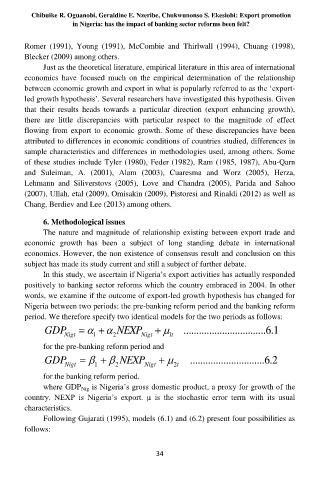
period. We therefore specify two identical models for the two periods as follows:
GDP Nigt NEXP Nigt .......... .......... .......... 1 . 6 ..
1
1t
2
for the pre-banking reform period and
GDP Nigt 2 NEXP Nigt 2t .......... .......... ......... 2 . 6
1
for the banking reform period.
where GDP Nig is Nigeria‟s gross domestic product, a proxy for growth of the
country. NEXP is Nigeria‟s export. µ is the stochastic error term with its usual
characteristics.
Following Gujarati (1995), models (6.1) and (6.2) present four possibilities as
follows:
34

