


Page 58 - Azerbaijan State University of Economics
P. 58
THE                      JOURNAL OF ECONOMIC SCIENCES: THEORY AND PRACTICE, V.82, # 1, 2025, pp. 52-69

                    approaches  focus  on  investigating  how,  why,  and  under  what  conditions  these
                    relationships  occur.  In  this  regard,  the  concepts  of  mediation  and  moderation  are
                    analytical approaches widely used in social sciences and applied statistics. Mediation
                    analysis examines whether the effect of one variable (independent variable – X) on
                    another  variable  (dependent  variable  –  Y)  is  mediated  through  a  third  variable
                    (mediator – M). This approach aims to clarify the mechanisms behind the cause-effect
                    relationship. For example, indirect effect is studied through the sequence X → M →
                    Y. If the effect of X on Y is mediated by the variable M, this effect is considered a
                    "mediation effect." Moderation analysis examines whether the relationship between
                    X and Y changes depending on the level of another variable (Z). This variable is called
                    a moderator. If the variable Z changes the direction or strength of the relationship,
                    then Z has a moderating role. This  model is  usually analyzed through interaction
                    effects and answers the question: "Does the effect of X on Y change due to Z?"
                    The PROCESS macro introduced by Andrew F. Hayes (2018), used in this article, is
                    a tool that simplifies the implementation of mediation, moderation, and conditional
                    process models in SPSS and other statistical programs. Macro offers more than 90
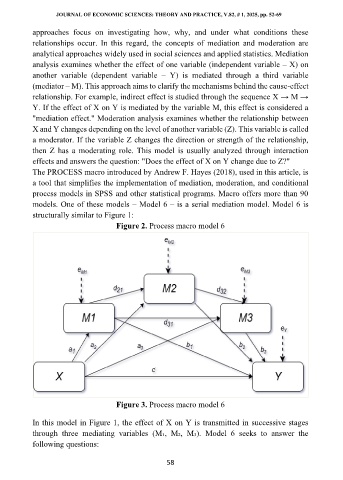
                    models. One of these models – Model 6 – is a serial mediation model. Model 6 is
                    structurally similar to Figure 1:
                                            Figure 2. Process macro model 6


                                            Figure 3. Process macro model 6

                    In this model in Figure 1, the effect of X on Y is transmitted in successive stages
                    through  three  mediating  variables  (M₁,  M₂,  M₃).  Model  6  seeks  to  answer  the
                    following questions:


                                                           58

