


Page 61 - Azerbaijan State University of Economics
P. 61
Shaig E.Kazimov: More Than Just Unemployment: How the Fear Of Not Finding A Job Shapes Life
                        Satisfaction In Azerbaijan


                    Model 1: Categorical Job Insecurity
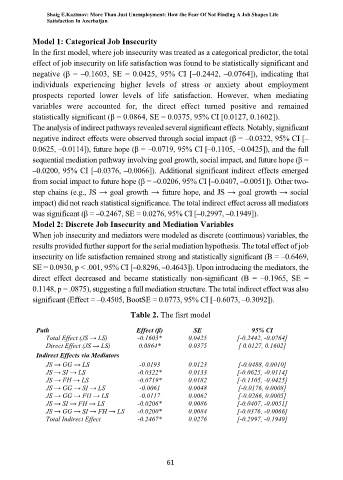
                    In the first model, where job insecurity was treated as a categorical predictor, the total
                    effect of job insecurity on life satisfaction was found to be statistically significant and
                    negative (β = –0.1603, SE = 0.0425, 95% CI [–0.2442, –0.0764]), indicating that
                    individuals  experiencing  higher  levels  of  stress  or  anxiety  about  employment
                    prospects  reported  lower  levels  of  life  satisfaction.  However,  when  mediating
                    variables  were  accounted  for,  the  direct  effect  turned  positive  and  remained
                    statistically significant (β = 0.0864, SE = 0.0375, 95% CI [0.0127, 0.1602]).
                    The analysis of indirect pathways revealed several significant effects. Notably, significant
                    negative indirect effects were observed through social impact (β = –0.0322, 95% CI [–
                    0.0625, –0.0114]), future hope (β = –0.0719, 95% CI [–0.1105, –0.0425]), and the full
                    sequential mediation pathway involving goal growth, social impact, and future hope (β =
                    –0.0200, 95% CI [–0.0376, –0.0066]). Additional significant indirect effects emerged
                    from social impact to future hope (β = –0.0206, 95% CI [–0.0407, –0.0051]). Other two-
                    step chains (e.g., JS → goal growth → future hope, and JS → goal growth → social
                    impact) did not reach statistical significance. The total indirect effect across all mediators
                    was significant (β = –0.2467, SE = 0.0276, 95% CI [–0.2997, –0.1949]).
                    Model 2: Discrete Job Insecurity and Mediation Variables
                    When job insecurity and mediators were modeled as discrete (continuous) variables, the
                    results provided further support for the serial mediation hypothesis. The total effect of job
                    insecurity on life satisfaction remained strong and statistically significant (B = –0.6469,
                    SE = 0.0930, p < .001, 95% CI [–0.8296, –0.4643]). Upon introducing the mediators, the
                    direct  effect  decreased  and  became  statistically  non-significant  (B  =  –0.1965,  SE  =
                    0.1148, p = .0875), suggesting a full mediation structure. The total indirect effect was also
                    significant (Effect = –0.4505, BootSE = 0.0773, 95% CI [–0.6073, –0.3092]).

                                                 Table 2. The fisrt model

                     Path                         Effect (β)       SE                95% CI
                        Total Effect (JS → LS)     -0.1603*       0.0425        [-0.2442, -0.0764]
                        Direct Effect (JS → LS)    0.0864*        0.0375         [ 0.0127, 0.1602]
                     Indirect Effects via Mediators
                        JS → GG → LS               -0.0193        0.0123         [-0.0488, 0.0010]
                        JS → SI → LS               -0.0322*       0.0133        [-0.0625, -0.0114]
                        JS → FH → LS               -0.0719*       0.0182        [-0.1105, -0.0425]
                        JS → GG → SI → LS          -0.0061        0.0048         [-0.0176, 0.0008]
                        JS → GG → FH → LS          -0.0117        0.0062         [-0.0266, 0.0005]
                        JS → SI → FH → LS          -0.0206*       0.0086        [-0.0407, -0.0051]
                        JS → GG → SI → FH → LS     -0.0200*       0.0084        [-0.0376, -0.0066]
                        Total Indirect Effect      -0.2467*       0.0276        [-0.2997, -0.1949]


                                                           61

