


Page 60 - Azerbaijan State University of Economics
P. 60
THE                      JOURNAL OF ECONOMIC SCIENCES: THEORY AND PRACTICE, V.82, # 1, 2025, pp. 52-69

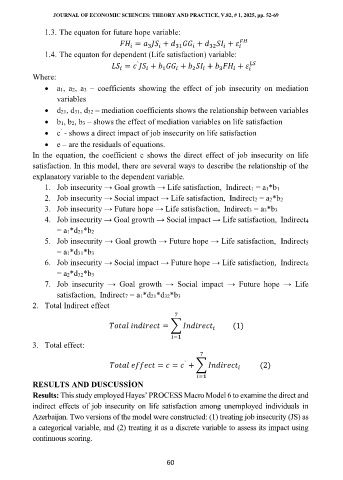
                       1.3. The equaton for future hope variable:
                                                   =         +         +         +


                                                                        32
                                                              31


                                                      3
                       1.4. The equaton for dependent (Life satisfaction) variable:

                                                   `
                                                =         +         +         +         +


                                                          1

                                                                           3


                                                                   2
                    Where:
                       •  a1,  a2,  a3  –  coefficients  showing  the  effect  of  job  insecurity  on  mediation
                           variables
                       •  d21, d31, d32 – mediation coefficients shows the relationship between variables
                       •  b1, b2, b3 – shows the effect of mediation variables on life satisfaction
                            `
                       •  c  - shows a direct impact of job insecurity on life satisfaction
                       •  e – are the residuals of equations.
                    In  the  equation,  the  coefficient  c  shows  the  direct  effect  of  job  insecurity  on  life
                    satisfaction. In this model, there are several ways to describe the relationship of the
                    explanatory variable to the dependent variable.
                       1.  Job insecurity → Goal growth → Life satisfaction,  Indirect1 = a1*b1
                       2.  Job insecurity → Social impact → Life satisfaction,  Indirect2 = a2*b2
                       3.  Job insecurity → Future hope → Life satisfaction,  Indirect3 = a3*b3
                       4.  Job insecurity → Goal growth → Social impact → Life satisfaction,  Indirect4
                           = a1*d21*b2
                       5.  Job insecurity → Goal growth → Future hope → Life satisfaction,  Indirect5
                           = a1*d31*b3
                       6.  Job insecurity → Social impact → Future hope → Life satisfaction,  Indirect6
                           = a2*d32*b3
                       7.  Job  insecurity  →  Goal  growth  →  Social  impact  →  Future  hope  →  Life
                           satisfaction,  Indirect7 = a1*d21*d32*b3
                    2.  Total Indirect effect
                                                              7
                                                                      = ∑                           (1)

                                                               =1
                    3.  Total effect:
                                                                     7
                                                                 `
                                                                   =    =    + ∑                            (2)

                                                                      =1
                    RESULTS AND DUSCUSSİON
                    Results: This study employed Hayes’ PROCESS Macro Model 6 to examine the direct and
                    indirect effects of job insecurity on life satisfaction among unemployed individuals in
                    Azerbaijan. Two versions of the model were constructed: (1) treating job insecurity (JS) as
                    a categorical variable, and (2) treating it as a discrete variable to assess its impact using
                    continuous scoring.


                                                           60

