


Page 133 - Azerbaijan State University of Economics
P. 133
THE                 JOURNAL OF ECONOMIC SCIENCES: THEORY AND PRACTICE, V.82, # 2, 2025, pp. 117-137

                    DISCUSSION
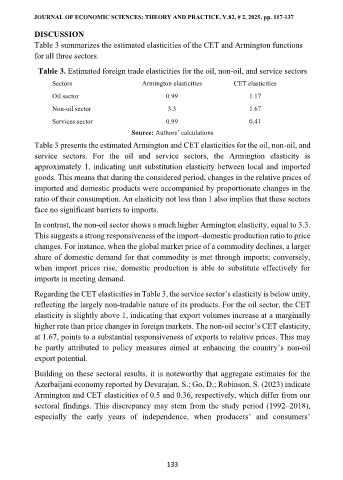
                    Table 3 summarizes the estimated elasticities of the CET and Armington functions
                    for all three sectors.

                     Table 3. Estimated foreign trade elasticities for the oil, non-oil, and service sectors
                         Sectors                    Armington elasticities     CET elasticities

                         Oil sector                        0.99                    1.17
                         Non-oil sector                    3.3                     1.67
                         Services sector                   0.99                    0.41
                                                Source: Authors’ calculations
                    Table 3 presents the estimated Armington and CET elasticities for the oil, non-oil, and
                    service  sectors.  For  the  oil  and  service  sectors,  the  Armington  elasticity  is
                    approximately 1, indicating unit substitution elasticity between local and imported
                    goods. This means that during the considered period, changes in the relative prices of
                    imported and domestic products were accompanied by proportionate changes in the
                    ratio of their consumption. An elasticity not less than 1 also implies that these sectors
                    face no significant barriers to imports.

                    In contrast, the non-oil sector shows a much higher Armington elasticity, equal to 3.3.
                    This suggests a strong responsiveness of the import–domestic production ratio to price
                    changes. For instance, when the global market price of a commodity declines, a larger
                    share of domestic demand for that commodity is met through imports; conversely,
                    when  import  prices  rise,  domestic  production  is  able  to  substitute  effectively  for
                    imports in meeting demand.

                    Regarding the CET elasticities in Table 3, the service sector’s elasticity is below unity,
                    reflecting the largely non-tradable nature of its products. For the oil sector, the CET
                    elasticity is slightly above 1, indicating that export volumes increase at a marginally
                    higher rate than price changes in foreign markets. The non-oil sector’s CET elasticity,
                    at 1.67, points to a substantial responsiveness of exports to relative prices. This may
                    be  partly  attributed  to  policy  measures  aimed  at  enhancing  the  country’s  non-oil
                    export potential.

                    Building on these sectoral results, it is noteworthy that aggregate estimates for the
                    Azerbaijani economy reported by Devarajan, S.; Go, D.; Robinson, S. (2023) indicate
                    Armington and CET elasticities of 0.5 and 0.36, respectively, which differ from our
                    sectoral findings. This discrepancy may stem from the study period (1992–2018),
                    especially  the  early  years  of  independence,  when  producers’  and  consumers’


                                                           133

