


Page 131 - Azerbaijan State University of Economics
P. 131
THE JOURNAL OF ECONOMIC SCIENCES: THEORY AND PRACTICE, V.82, # 2, 2025, pp. 117-137
Based on the model results, the elasticity of substitution between products sold in the
domestic and foreign markets in the oil sector was calculated as follows:
1
= = 1.17
1 − 0.14
As can be seen, the elasticity between domestically produced oil products sold on the
local market and exported abroad is slightly greater than unity. This indicates that
there is potential to increase exports of oil products currently sold domestically.
According to formula (6), the sale of domestically produced oil products in foreign
markets tends to increase relative to sales in the domestic market. More precisely,
based on the first-order condition, a 1% increase in the foreign market price of goods
and services in this sector raises the ratio of domestic-to-export sales of domestically
produced goods and services in this sector by 1.17%.
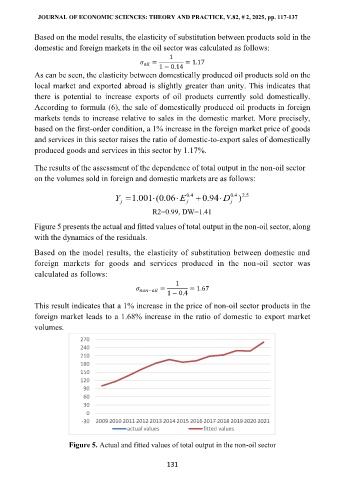
The results of the assessment of the dependence of total output in the non-oil sector
on the volumes sold in foreign and domestic markets are as follows:
Y = . 1 001 . 0 ( 06 E 4 . 0 + . 0 94 D 4 . 0 ) 5 . 2
j j j
R2=0.99, DW=1.41
Figure 5 presents the actual and fitted values of total output in the non-oil sector, along
with the dynamics of the residuals.
Based on the model results, the elasticity of substitution between domestic and
foreign markets for goods and services produced in the non-oil sector was
calculated as follows:
1
− = = 1.67
1 − 0.4
This result indicates that a 1% increase in the price of non-oil sector products in the
foreign market leads to a 1.68% increase in the ratio of domestic to export market
volumes.
270
240
210
180
150
120
90
60
30
0
-30 2009 2010 2011 2012 2013 2014 2015 2016 2017 2018 2019 2020 2021
actual values fitted values
Figure 5. Actual and fitted values of total output in the non-oil sector
131

