


Page 43 - Azerbaijan State University of Economics
P. 43
Fatih Chellai: Regime-Dependent Effects of Public Spending in Algeria: A Structural VAR and
                                                           Markov-Switching Approach

                    Identification of structural shocks
                    The choice of this matrix of contemporary restrictions for the SVAR model is based on a
                    theoretical  logic  consistent  with  macroeconomic  transmission  mechanisms  and  the
                    institutional specificities of the Algerian economy. In this matrix, real GDP (LPIB) is placed
                    in first position and assumed not to react to any shocks from other variables at the moment,
                    which is economically justified by the fact that aggregate output takes time to adjust to
                    economic shocks, especially in a country like Algeria where delays in implementing public
                    policies and structural rigidities are frequent. Real public expenditure (EXP), on the other
                    hand, can react immediately to the level of GDP, reflecting potentially counter-cyclical
                    behavior on the part of the government, which adjusts its spending in line with current
                    economic performance (e.g., higher spending in the event of slower growth). However,
                    EXP is assumed not to react instantly to inflation or unemployment, as budgetary decisions
                    often require a slower adjustment process, particularly in rigid institutional contexts.

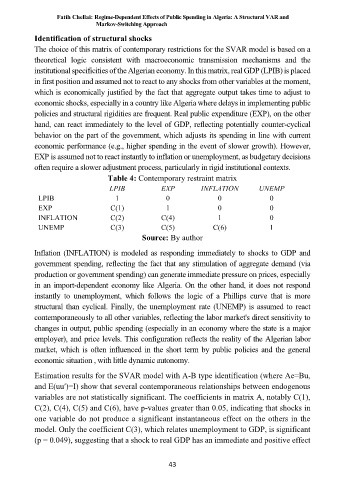
                                         Table 4: Contemporary restraint matrix
                                          LPIB           EXP         INFLATION        UNEMP
                     LPIB                   1              0              0              0
                     EXP                  C(1)             1              0              0
                     INFLATION            C(2)           C(4)             1              0
                     UNEMP                C(3)           C(5)            C(6)            1
                                                    Source: By author

                    Inflation (INFLATION) is modeled as responding immediately to shocks to GDP and
                    government spending, reflecting the fact that any stimulation of aggregate demand (via
                    production or government spending) can generate immediate pressure on prices, especially
                    in an import-dependent economy like Algeria. On the other hand, it does not respond
                    instantly  to  unemployment,  which  follows  the  logic  of  a  Phillips  curve  that  is  more
                    structural than cyclical. Finally, the unemployment rate (UNEMP) is assumed to react
                    contemporaneously to all other variables, reflecting the labor market's direct sensitivity to
                    changes in output, public spending (especially in an economy where the state is a major
                    employer), and price levels. This configuration reflects the reality of the Algerian labor
                    market, which is often influenced in the short term by public policies and the general
                    economic situation , with little dynamic autonomy.

                    Estimation results for the SVAR model with A-B type identification (where Ae=Bu,
                    and E(uu′)=I) show that several contemporaneous relationships between endogenous
                    variables are not statistically significant. The coefficients in matrix A, notably C(1),
                    C(2), C(4), C(5) and C(6), have p-values greater than 0.05, indicating that shocks in
                    one variable do not produce a significant instantaneous effect on the others in the
                    model. Only the coefficient C(3), which relates unemployment to GDP, is significant
                    (p = 0.049), suggesting that a shock to real GDP has an immediate and positive effect


                                                           43

