


Page 46 - Azerbaijan State University of Economics
P. 46
THE                      JOURNAL OF ECONOMIC SCIENCES: THEORY AND PRACTICE, V.82, # 2, 2025, pp. 32-60


                                     Response to Cholesky One S.D. (d.f. adjusted) Innovations
                                             95% CI using analytic asymptotic S.E.s
                           Response of GDP to Exp Innovation        Response of Exp to Exp Innovation

                    .016
                                                            .024
                    .012                                    .020
                                                            .016
                    .008
                                                            .012
                    .004                                    .008
                                                            .004
                    .000
                                                            .000
                        1   2  3   4  5   6  7  8   9  10        1  2   3  4   5  6   7  8  9  10

                         Response of INFLATION to Exp Innovation   Response of Unemp to Exp Innovation

                     .75
                                                              .8
                     .50
                                                              .6
                     .25
                                                              .4
                     .00
                                                              .2
                    -.25
                                                              .0
                    -.50
                                                              -.2
                    -.75
                        1   2  3   4  5   6  7  8   9  10        1  2   3  4   5  6   7  8  9  10

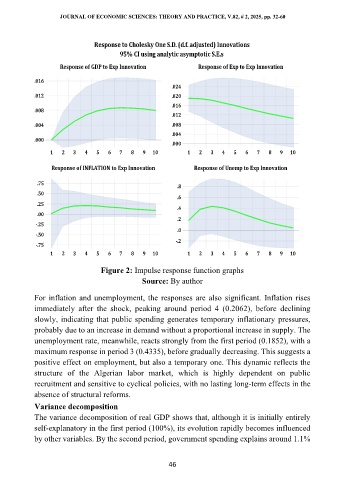
                                       Figure 2: Impulse response function graphs
                                                    Source: By author

                    For inflation and unemployment, the responses are also significant.  Inflation rises
                    immediately  after  the  shock,  peaking  around  period  4  (0.2062),  before  declining
                    slowly, indicating that public spending generates temporary inflationary pressures,
                    probably due to an increase in demand without a proportional increase in supply. The
                    unemployment rate, meanwhile, reacts strongly from the first period (0.1852), with a
                    maximum response in period 3 (0.4335), before gradually decreasing. This suggests a
                    positive effect on employment, but also a temporary one. This dynamic reflects the
                    structure  of  the  Algerian  labor  market,  which  is  highly  dependent  on  public
                    recruitment and sensitive to cyclical policies, with no lasting long-term effects in the
                    absence of structural reforms.

                    Variance decomposition
                    The variance decomposition of real GDP shows that, although it is initially entirely
                    self-explanatory in the first period (100%), its evolution rapidly becomes influenced
                    by other variables. By the second period, government spending explains around 1.1%


                                                           46

