


Page 45 - Azerbaijan State University of Economics
P. 45
Fatih Chellai: Regime-Dependent Effects of Public Spending in Algeria: A Structural VAR and
                                                            Markov-Switching Approach


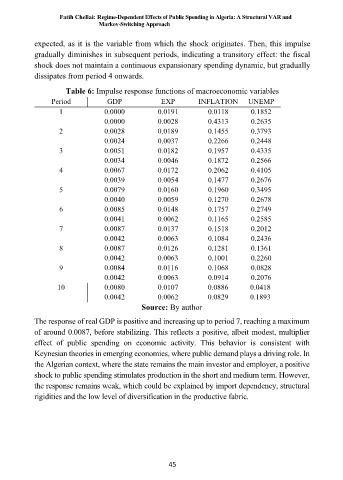
                    expected, as it is the variable from which the shock originates. Then, this impulse
                    gradually diminishes in subsequent periods, indicating a transitory effect: the fiscal
                    shock does not maintain a continuous expansionary spending dynamic, but gradually
                    dissipates from period 4 onwards.

                             Table 6: Impulse response functions of macroeconomic variables
                         Period          GDP             EXP        INFLATION      UNEMP
                           1            0.0000          0.0191         0.0118       0.1852
                                        0.0000          0.0028         0.4313       0.2635
                           2            0.0028          0.0189         0.1455       0.3793
                                        0.0024          0.0037         0.2266       0.2448
                           3            0.0051          0.0182         0.1957       0.4335
                                        0.0034          0.0046         0.1872       0.2566
                           4            0.0067          0.0172         0.2062       0.4105
                                        0.0039          0.0054         0.1477       0.2676
                           5            0.0079          0.0160         0.1960       0.3495
                                        0.0040          0.0059         0.1270       0.2678
                           6            0.0085          0.0148         0.1757       0.2749
                                        0.0041          0.0062         0.1165       0.2585
                           7            0.0087          0.0137         0.1518       0.2012
                                        0.0042          0.0063         0.1084       0.2436
                           8            0.0087          0.0126         0.1281       0.1361
                                        0.0042          0.0063         0.1001       0.2260
                           9            0.0084          0.0116         0.1068       0.0828
                                        0.0042          0.0063         0.0914       0.2076
                           10           0.0080          0.0107         0.0886       0.0418
                                        0.0042          0.0062         0.0829       0.1893
                                                   Source: By author

                    The response of real GDP is positive and increasing up to period 7, reaching a maximum
                    of around 0.0087, before stabilizing. This reflects a positive, albeit modest, multiplier
                    effect  of  public  spending  on  economic  activity.  This  behavior  is  consistent  with
                    Keynesian theories in emerging economies, where public demand plays a driving role. In
                    the Algerian context, where the state remains the main investor and employer, a positive
                    shock to public spending stimulates production in the short and medium term. However,
                    the response remains weak, which could be explained by import dependency, structural
                    rigidities and the low level of diversification in the productive fabric.


                                                           45

