


Page 50 - Azerbaijan State University of Economics
P. 50
THE                      JOURNAL OF ECONOMIC SCIENCES: THEORY AND PRACTICE, V.82, # 2, 2025, pp. 32-60

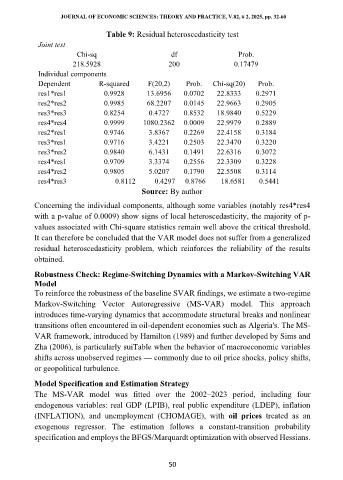
                                         Table 9: Residual heteroscedasticity test
                     Joint test
                                Chi-sq                      df                  Prob.
                               218.5928                    200                 0.17479
                     Individual components
                     Dependent         R-squared     F(20,2)     Prob.   Chi-sq(20)   Prob.
                     res1*res1          0.9928       13.6956    0.0702    22.8333    0.2971
                     res2*res2          0.9985       68.2207    0.0145    22.9663    0.2905
                     res3*res3          0.8254        0.4727    0.8532    18.9840    0.5229
                     res4*res4          0.9999      1080.2362  0.0009     22.9979    0.2889
                     res2*res1          0.9746        3.8367    0.2269    22.4158    0.3184
                     res3*res1          0.9716        3.4221    0.2503    22.3470    0.3220
                     res3*res2          0.9840        6.1431    0.1491    22.6316    0.3072
                     res4*res1          0.9709        3.3374    0.2556    22.3309    0.3228
                     res4*res2          0.9805        5.0207    0.1790    22.5508    0.3114
                     res4*res3              0.8112     0.4297   0.8766     18.6581    0.5441
                                                   Source: By author

                    Concerning the individual components, although some variables (notably res4*res4
                    with a p-value of 0.0009) show signs of local heteroscedasticity, the majority of p-
                    values associated with Chi-square statistics remain well above the critical threshold.
                    It can therefore be concluded that the VAR model does not suffer from a generalized
                    residual  heteroscedasticity  problem,  which  reinforces  the  reliability  of  the  results
                    obtained.

                    Robustness Check: Regime-Switching Dynamics with a Markov-Switching VAR
                    Model
                    To reinforce the robustness of the baseline SVAR findings, we estimate a two-regime
                    Markov-Switching  Vector  Autoregressive  (MS-VAR)  model.  This  approach
                    introduces time-varying dynamics that accommodate structural breaks and nonlinear
                    transitions often encountered in oil-dependent economies such as Algeria's. The MS-
                    VAR framework, introduced by Hamilton (1989) and further developed by Sims and
                    Zha (2006), is particularly suiTable when the behavior of macroeconomic variables
                    shifts across unobserved regimes — commonly due to oil price shocks, policy shifts,
                    or geopolitical turbulence.

                    Model Specification and Estimation Strategy
                    The  MS-VAR  model  was  fitted  over  the  2002–2023  period,  including  four
                    endogenous variables: real GDP (LPIB), real public expenditure (LDEP), inflation
                    (INFLATION),  and  unemployment  (CHOMAGE),  with  oil  prices  treated  as  an
                    exogenous  regressor.  The  estimation  follows  a  constant-transition  probability
                    specification and employs the BFGS/Marquardt optimization with observed Hessians.


                                                           50

