


Page 32 - Azerbaijan State University of Economics
P. 32
THE JOURNAL OF ECONOMIC SCIENCES: THEORY AND PRACTICE, V.73, # 1, 2016, pp. 4-37


                      GDP growth,%
                      The Index of
                      nominal GDP        100   121   135   169   236   312   443   573   729   630  806
                      growth,%
                      The Index of
                      nominal growth of
                      the final product by   100   111   131   147   157   171   193   219   223   239  281
                      formula
                      рр*NGDP,%
                      The Index of real
                      growth of the final   100   111   131   147   157   171   193   219   223   239  281
                      product by formula
                      c*RGDP%
                         Source: The Statistical Committee of the Republic of Kazakhstan

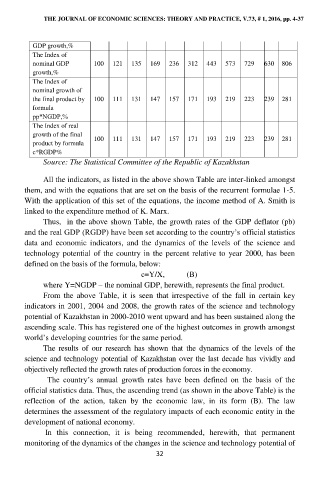
                         All the indicators, as listed in the above shown Table are inter-linked amongst
                    them, and with the equations that are set on the basis of the recurrent formulae 1-5.
                    With the application of this set of the equations, the income method of A. Smith is
                    linked to the expenditure method of K. Marx.
                         Thus,  in the above shown Table, the growth rates of the GDP deflator (pb)
                    and the real GDP (RGDP) have been set according to the country‘s official statistics
                    data  and  economic  indicators,  and  the  dynamics  of  the  levels  of  the  science  and
                    technology potential of the country in the percent relative to  year 2000, has been
                    defined on the basis of the formula, below:
                                                       с=Y/X,           (B)
                         where Y=NGDP – the nominal GDP, herewith, represents the final product.
                         From  the  above  Table,  it  is  seen  that  irrespective  of  the  fall  in  certain  key
                    indicators in 2001, 2004 and 2008, the growth rates of the science and technology
                    potential of Kazakhstan in 2000-2010 went upward and has been sustained along the
                    ascending scale. This has registered one of the highest outcomes in growth amongst
                    world‘s developing countries for the same period.
                         The  results  of  our  research  has  shown  that  the  dynamics  of  the  levels  of  the
                    science and technology potential of Kazakhstan over the last decade has vividly and
                    objectively reflected the growth rates of production forces in the economy.
                           The  country‘s  annual  growth  rates  have  been  defined  on  the  basis  of  the
                    official statistics data. Thus, the ascending trend (as shown in the above Table) is the
                    reflection  of  the  action,  taken  by  the  economic  law,  in  its  form  (B).  The  law
                    determines the assessment of the regulatory impacts of each economic entity in the
                    development of national economy.
                          In  this  connection,  it  is  being  recommended,  herewith,  that  permanent
                    monitoring of the dynamics of the changes in the science and technology potential of

                                                           32

