


Page 24 - Azerbaijan State University of Economics
P. 24
THE                      JOURNAL OF ECONOMIC SCIENCES: THEORY AND PRACTICE, V.81, # 2, 2024, pp. 4-29

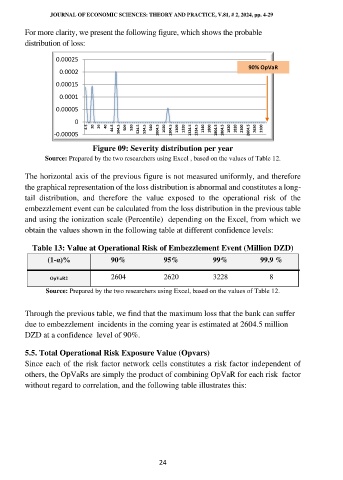
                    For more clarity, we present the following figure, which shows the probable
                    distribution of loss:

                             0.00025
                                                                                      90% OpVaR
                              0.0002
                             0.00015
                              0.0001
                             0.00005

                                   0
                                      4.5  20  29  40  44.5  504.5  509  520  524.5  524.5  540  1004.5  1020  1304.5  1309  1320  1324.5  1324.5  1340  1800  1804.5  1804.5  1820  1820  2300  2604.5  2620  3100
                            -0.00005

                                        Figure 09: Severity distribution per year
                          Source: Prepared by the two researchers using Excel , based on the values of Table 12.

                    The horizontal axis of the previous figure is not measured uniformly, and therefore
                    the graphical representation of the loss distribution is abnormal and constitutes a long-
                    tail  distribution,  and  therefore  the  value  exposed  to  the  operational  risk  of  the
                    embezzlement event can be calculated from the loss distribution in the previous table
                    and using the ionization scale (Percentile)  depending on the Excel, from which we
                    obtain the values shown in the following table at different confidence levels:

                      Table 13: Value at Operational Risk of Embezzlement Event (Million DZD)
                          (1-α)%             90%             95%           99%           99.9 %


                           OpVaR2            2604            2620          3228             8
                          Source: Prepared by the two researchers using Excel, based on the values of Table 12.


                    Through the previous table, we find that the maximum loss that the bank can suffer
                    due to embezzlement  incidents in the coming year is estimated at 2604.5 million
                    DZD at a confidence  level of 90%.

                    5.5. Total Operational Risk Exposure Value (Opvars)
                    Since each of the risk factor network cells constitutes a risk factor independent of
                    others, the OpVaRs are simply the product of combining OpVaR for each risk  factor
                    without regard to correlation, and the following table illustrates this:


                                                           24

