


Page 99 - Azerbaijan State University of Economics
P. 99
THE JOURNAL OF ECONOMIC SCIENCES: THEORY AND PRACTICE


               Hence,  banking  system  of  Ukraine  fulfils  funds  transformation  functions

               inefficiently and by itself imposes risk for financial stability.
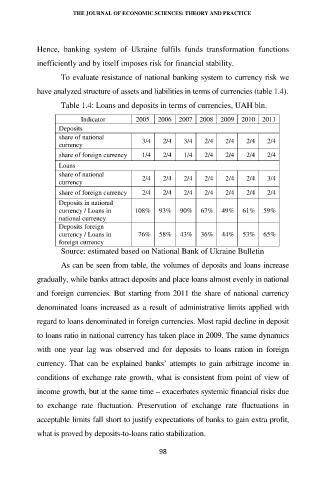
                      To evaluate resistance of national banking system to currency risk we

               have analyzed structure of assets and liabilities in terms of currencies (table 1.4).

                      Table 1.4: Loans and deposits in terms of currencies, UAH bln.
                            Indicator        2005   2006  2007  2008  2009  2010  2011
                      Deposits
                      share of national
                      currency                 3/4    2/4    3/4    2/4    2/4    2/4    2/4
                      share of foreign currency    1/4    2/4    1/4    2/4    2/4    2/4    2/4
                      Loans
                      share of national
                      currency                 2/4    2/4    2/4    2/4    2/4    2/4    3/4
                      share of foreign currency    2/4    2/4    2/4    2/4    2/4    2/4    2/4
                      Deposits in national
                      currency / Loans in   108%   93%    90%  67%    49%   61%  59%
                      national currency
                      Deposits foreign
                      currency / Loans in    76%   58%    43%  36%    44%   53%  65%
                      foreign currency
                      Source: estimated based on National Bank of Ukraine Bulletin

                      As can be seen from table, the volumes of deposits and loans increase

               gradually, while banks attract deposits and place loans almost evenly in national
               and foreign currencies. But starting from 2011 the share of national currency

               denominated  loans  increased  as  a  result  of  administrative  limits  applied  with

               regard to loans denominated in foreign currencies. Most rapid decline in deposit
               to loans ratio in national currency has taken place in 2009. The same dynamics

               with  one  year  lag  was  observed  and  for  deposits  to  loans  ration  in  foreign
               currency.  That  can  be  explained  banks’  attempts  to  gain  arbitrage  income  in

               conditions of exchange rate growth, what is consistent from point of view of
               income growth, but at the same time – exacerbates systemic financial risks due

               to  exchange  rate  fluctuation.  Preservation  of  exchange  rate  fluctuations  in

               acceptable limits fall short to justify expectations of banks to gain extra profit,
               what is proved by deposits-to-loans ratio stabilization.


                                                       98

