


Page 39 - Azerbaijan State University of Economics
P. 39
THE JOURNAL OF ECONOMIC SCIENCES: THEORY AND PRACTICE, V.76, # 2, 2019, pp. 31-45


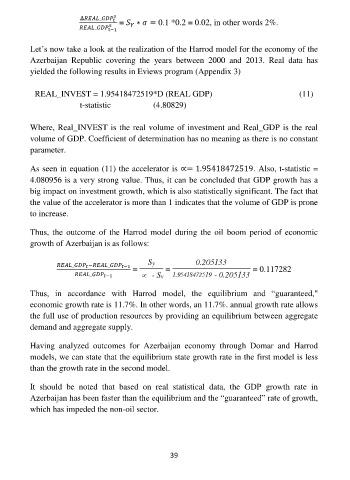
                                  Δ        _              =    ∗    = 0.1 *0.2 = 0.02, in other words 2%.
                                          s
                                          _       t−1

                    Let’s now take a look at the realization of the Harrod model for the economy of the
                    Azerbaijan  Republic  covering  the  years  between  2000  and  2013.  Real  data  has
                    yielded the following results in Eviews program (Appendix 3)

                     REAL_INVEST = 1.95418472519*D (REAL GDP)                                         (11)
                                         t-statistic                    (4.80829)

                    Where, Real_INVEST is the real volume of investment and Real_GDP is the real
                    volume of GDP. Coefficient of determination has no meaning as there is no constant
                    parameter.

                    As seen in equation (11) the accelerator is ∝= 1.95418472519. Also, t-statistic =
                    4.080956 is a very strong value. Thus, it can be concluded that GDP growth has a
                    big impact on investment growth, which is also statistically significant. The fact that
                    the value of the accelerator is more than 1 indicates that the volume of GDP is prone
                    to increase.

                    Thus,  the  outcome  of  the  Harrod  model  during  the  oil  boom  period  of economic
                    growth of Azerbaijan is as follows:

                                   _          −        _         −1
                                                 =         =                       = 0.117282
                                        _         −1

                    Thus,  in  accordance  with  Harrod  model,  the  equilibrium  and  “guaranteed,"
                    economic growth rate is 11.7%. In other words, an 11.7%. annual growth rate allows
                    the full use of production resources by providing an equilibrium between aggregate
                    demand and aggregate supply.

                    Having  analyzed  outcomes  for  Azerbaijan  economy  through  Domar  and  Harrod
                    models, we can state that the equilibrium state growth rate in the first model is less
                    than the growth rate in the second model.

                    It  should  be  noted  that  based  on  real  statistical  data,  the  GDP  growth  rate  in
                    Azerbaijan has been faster than the equilibrium and the “guaranteed” rate of growth,
                    which has impeded the non-oil sector.


                                                           39

