


Page 41 - Azerbaijan State University of Economics
P. 41
THE JOURNAL OF ECONOMIC SCIENCES: THEORY AND PRACTICE, V.76, # 2, 2019, pp. 31-45


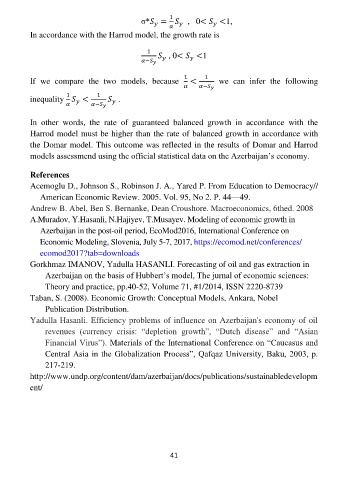
                                                           1
                                                   σ*   =      ,   0<    <1,


                    In accordance with the Harrod model, the growth rate is

                                                     1
                                                            , 0<    <1


                                                     −

                    If  we  compare  the  two  models,  because   1  <  1  we  can  infer  the  following
                                                                      −
                              1        1
                    inequality     <          .


                                       −

                    In  other  words,  the  rate  of  guaranteed  balanced  growth  in  accordance  with  the
                    Harrod model must be higher than the rate of balanced growth in accordance with
                    the Domar model. This outcome was reflected in the results of Domar and Harrod
                    models assessmend using the official statistical data on the Azerbaijan’s economy.

                    References
                    Acemoglu D., Johnson S., Robinson J. A., Yared P. From Education to Democracy//
                       American Economic Review. 2005. Vol. 95, No 2. P. 44—49.
                    Andrew B. Abel, Ben S. Bernanke, Dean Croushore. Macroeconomics, 6thed. 2008
                    A.Muradov, Y.Hasanli, N.Hajiyev, T.Musayev. Modeling of economic growth in
                       Azerbaijan in the post-oil period, EcoMod2016, International Conference on
                       Economic Modeling, Slovenia, July 5-7, 2017, https://ecomod.net/conferences/
                       ecomod2017?tab=downloads
                    Gorkhmaz IMANOV, Yadulla HASANLI. Forecasting of oil and gas extraction in
                        Azerbaijan on the basis of Hubbert’s model, The jurnal of economic sciences:
                        Theory and practice, pp.40-52, Volume 71, #1/2014, ISSN 2220-8739
                    Taban, S. (2008). Economic Growth: Conceptual Models, Ankara, Nobel
                        Publication Distribution.
                    Yadulla Hasanli. Efficiency problems of influence on Azerbaijan's economy of oil
                        revenues  (currency  crisis:  “depletion  growth”,  “Dutch  disease”  and  “Asian
                        Financial Virus”). Materials of the International Conference on “Caucasus and
                        Central Asia in the Globalization Process”, Qafqaz University, Baku, 2003, p.
                        217-219.
                    http://www.undp.org/content/dam/azerbaijan/docs/publications/sustainabledevelopm
                    ent/


                                                           41

