


Page 32 - Azerbaijan State University of Economics
P. 32
THE JOURNAL OF ECONOMIC SCIENCES: THEORY AND PRACTICE, V.77, # 2, 2020, pp. 4-39


                    * Statistically signi ficant at the level (α >= 0.01).
                    It is evident from the statistical results presented in Table No. (13), and from the
                    follow-up of the (t) test values that the following sub-variables related (leadership
                    attractiveness,  inspiring  motivation,  individual  interest)  have  an  impact  on  the
                    strategic  response  as  a  dimension  of  strategic  agility.  t)  calculated  (4.757,  2.631,
                    6.339), respectively, which are significant values at the level of significance (α >=
                    0.01). And that the related sub-variable (creative encouragement) has an impact on
                    the strategic response as a dimension of strategic agility, as the calculated (t) values
                    reached  (2.131),  respectively,  which  are  significant  values  at  the  level  of
                    significance (α >= 0.05).

                    From the above, the following requires: Rejecting the null hypothesis, which states
                    that: There is no statistically significant effect at the level of significance (α >= 0.05)
                    of transformational leadership in its dimensions (leadership attractiveness, inspiring
                    motivation, creative encouragement, individual interest) in the strategic response as
                    a dimension of Dimensions of strategic agility.

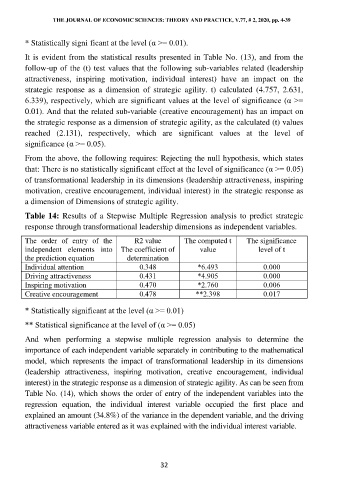
                    Table 14:  Results of a Stepwise Multiple Regression analysis to  predict  strategic
                    response through transformational leadership dimensions as independent variables.
                    The  order  of  entry  of  the   R2 value     The computed t     The significance
                    independent  elements  into  The coefficient of    value            level of t
                    the prediction equation       determination
                    Individual attention             0.348            * 6.493             0.000
                    Driving attractiveness           0.431            * 4.905             0.000
                    Inspiring motivation             0.470            * 2.760             0.006
                    Creative encouragement           0.478            ** 2.398            0.017

                    * Statistically significant at the level (α >= 0.01)

                    ** Statistical significance at the level of (α >= 0.05)
                    And  when  performing  a  stepwise  multiple  regression  analysis  to  determine  the
                    importance of each independent variable separately in contributing to the mathematical
                    model,  which  represents  the  impact  of  transformational  leadership  in  its  dimensions
                    (leadership  attractiveness,  inspiring  motivation,  creative  encouragement,  individual
                    interest) in the strategic response as a dimension of strategic agility. As can be seen from
                    Table No. (14), which shows the order of entry of the independent variables into the
                    regression  equation,  the  individual  interest  variable  occupied  the  first  place  and
                    explained an amount (34.8%) of the variance in the dependent variable, and the driving
                    attractiveness variable entered as it was explained with the individual interest variable.


                                                           32

