


Page 94 - Azerbaijan State University of Economics
P. 94
THE                      JOURNAL OF ECONOMIC SCIENCES: THEORY AND PRACTICE, V.81, # 2, 2024, pp. 84-103

                    This distribution suggests that initiatives aimed at improving resource efficiency and eco-
                    friendly practices should primarily focus on the production/operations and supply chain
                    and  transportation  departments,  where  most  employees  are  concentrated  and  where
                    significant environmental impacts can be managed.

                    Test of Hypotheses
                    To test the hypotheses, preliminary diagnostic analysis of the skewness and kurtosis
                    for the variables indicates that the data distributions are approximately symmetrical
                    and  normal.  The  skewness  values  for  climate  change  attitudinal  responses  (0.25),
                    action orientation (0.10), resource efficiency (0.12), and eco-friendly practices (0.35),
                    ranging from 0.10 to 0.35, are close to zero, suggesting minimal asymmetry in the
                    data.  The  kurtosis  values  for  climate  change  attitudinal  responses  (0.3),  action
                    orientation (0.4), resource efficiency (0.2), and eco-friendly practices (0.5), ranging
                    from 0.2 to 0.5, are within the acceptable range of 0 to 1, indicating that the data do
                    not exhibit extreme deviations in terms of peakedness or tails.

                    Furthermore, the VIF values for climate change attitudinal responses (1.5), action
                    orientation (2.0), resource efficiency (1.8), and eco-friendly practices (1.7), all below
                    the threshold of 10, confirming that multicollinearity is not a significant issue among
                    the  predictor  variables,  ensuring  their  independence.  These  statistical  measures
                    collectively  validate  the  appropriateness  of  using  linear  regression  to  test  the
                    hypotheses.

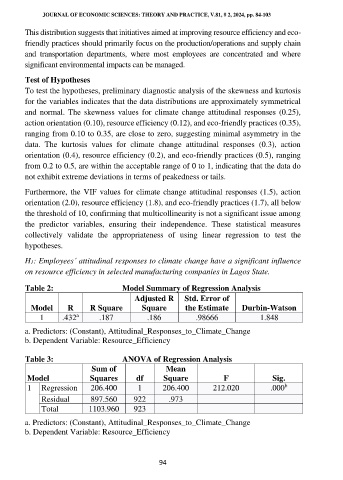
                    H1: Employees’ attitudinal responses to climate change have a significant influence
                    on resource efficiency in selected manufacturing companies in Lagos State.

                    Table 2:                     Model Summary of Regression Analysis
                                                    Adjusted R     Std. Error of
                     Model      R      R Square       Square       the Estimate     Durbin-Watson
                                   a
                        1      .432       .187          .186          .98666             1.848

                    a. Predictors: (Constant), Attitudinal_Responses_to_Climate_Change
                    b. Dependent Variable: Resource_Efficiency

                    Table 3:                     ANOVA of Regression Analysis
                                       Sum of                Mean
                    Model              Squares       df      Square            F             Sig.
                                                                                                 b
                    1    Regression    206.400       1      206.400        212.020          .000
                         Residual      897.560      922       .973
                         Total         1103.960     923

                    a. Predictors: (Constant), Attitudinal_Responses_to_Climate_Change
                    b. Dependent Variable: Resource_Efficiency


                                                           94

