


Page 95 - Azerbaijan State University of Economics
P. 95
Rasheed Olawale Azeez: Effects of Employees’ Climate Change Attitudinal Responses and
                         Action Orientation on Resource Efficiency and Eco-Friendly Practices in Manufacturing Firms

                    Table 4:Coefficients of Regression Analysis
                                                 Unstandardized  Standardized
                                                   Coefficients     Coefficients
                   Model                          B    Std. Error      Beta           t        Sig.
                   1     (Constant)             2.049     .118                     17.363      .000
                         Attitudinal_Responses .443       .030         .432        14.561      .000
                         _to_Climate_Change
                    Source: Field Survey (2024)

                    The linear regression analysis presented in Tables 2, 3, and 4 assesses the influence
                    of  employees’  attitudinal  responses  to  climate  change  on  resource  efficiency  in
                    selected manufacturing companies in Lagos State. The model summary in Table 2
                    indicates that the correlation coefficient (r) is 0.432, signifying a moderate positive
                    relationship  between  the  independent  variable  (attitudinal  responses  to  climate
                    change) and the dependent variable (resource efficiency).

                          2
                    The R  value of 0.187 suggests that approximately 18.7% of the variance in resource
                    efficiency can be explained by employees’ attitudes towards climate change. The Durbin-
                    Watson statistic of 1.848 is close to 2, suggesting no significant autocorrelation in the
                    residuals.  The  ANOVA  table  (Table  3)  provides  further  insight  into  the  regression
                    model’s statistical significance. The F-value of 212.020, with a significance level (Sig.)
                    of 0.000, indicates that the model is statistically significant and that there is a strong
                    likelihood that the relationship observed between attitudinal responses to climate change
                    and resource efficiency is not due to chance. The large F-value compared to the critical
                    F-value signifies that the model has a good fit for the data. Thus, employees’ attitudes
                    toward  climate  change  have  a  meaningful  impact  on  resource  efficiency  in  these
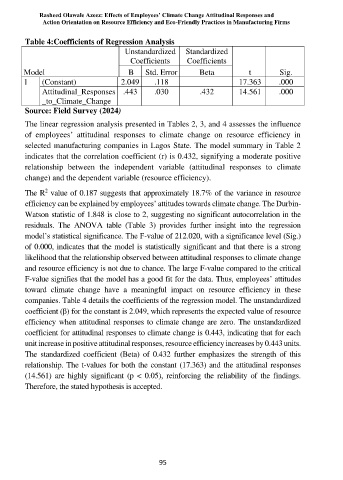
                    companies. Table 4 details the coefficients of the regression model. The unstandardized
                    coefficient (β) for the constant is 2.049, which represents the expected value of resource
                    efficiency when attitudinal responses to climate change are zero. The unstandardized
                    coefficient for attitudinal responses to climate change is 0.443, indicating that for each
                    unit increase in positive attitudinal responses, resource efficiency increases by 0.443 units.
                    The  standardized  coefficient  (Beta)  of  0.432  further  emphasizes  the  strength  of  this
                    relationship. The t-values for both the constant (17.363) and the attitudinal responses
                    (14.561)  are  highly  significant  (p  <  0.05),  reinforcing  the  reliability  of  the  findings.
                    Therefore, the stated hypothesis is accepted.


                                                           95

