


Page 97 - Azerbaijan State University of Economics
P. 97
Rasheed Olawale Azeez: Effects of Employees’ Climate Change Attitudinal Responses and
                      Action Orientation on Resource Efficiency and Eco-Friendly Practices in Manufacturing Firms

                    Table 5: Model Summary of Regression Analysis
                                                  Adjusted R      Std. Error of
                     Model      R     R Square      Square        the Estimate     Durbin-Watson
                                   a
                        1      .324     .105          .104          1.08918              1.631

                    a. Predictors: (Constant), Action_Orientation_Towards_Climate_Change
                    b. Dependent Variable: Adoption_of_Ecofriendly_Operational_Practices

                    Table 6: ANOVA of Regression Analysis
                                          Sum of
                    Model                Squares        df    Mean Square         F          Sig.
                                                                                                 b
                    1      Regression     127.861       1        127.861      107.780        .000
                            Residual     1093.779      922        1.186
                              Total      1221.640      923

                    a. Predictors: (Constant), Action_Orientation_Towards_Climate_Change
                    b. Dependent Variable: Adoption_of_Ecofriendly_Operational_Practices

                    Table 7: Coefficients of Regression Analysis
                                               Unstandardized    Standardized
                                                Coefficients      Coefficients
                                                          Std.
                               Model             B       Error       Beta          t       Sig.
                        1    (Constant)        2.462     .115                   21.336     .000
                         Action_Orientation    .323      .031        .324       10.382     .000
                         _Towards_Climate
                              _Change
                               Source: Field Survey (2024)

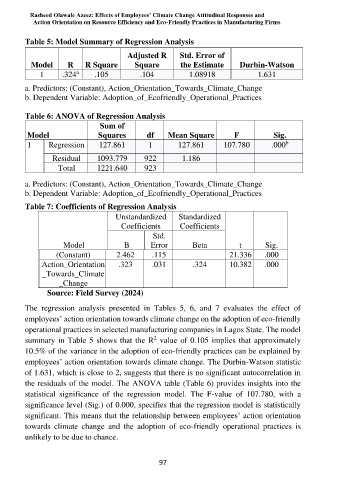
                    The  regression  analysis  presented  in  Tables  5,  6,  and  7  evaluates  the  effect  of
                    employees’ action orientation towards climate change on the adoption of eco-friendly
                    operational practices in selected manufacturing companies in Lagos State. The model
                                                          2
                    summary in Table 5 shows that the R  value of 0.105 implies that approximately
                    10.5% of the variance in the adoption of eco-friendly practices can be explained by
                    employees’ action orientation towards climate change. The Durbin-Watson statistic
                    of 1.631, which is close to 2, suggests that there is no significant autocorrelation in
                    the residuals of the model. The ANOVA table (Table 6) provides insights into the
                    statistical  significance  of  the  regression  model.  The  F-value  of  107.780,  with  a
                    significance level (Sig.) of 0.000, specifies that the regression model is statistically
                    significant. This means that the relationship between employees’ action orientation
                    towards  climate  change  and  the  adoption  of  eco-friendly  operational  practices  is
                    unlikely to be due to chance.


                                                           97

